
Last updated September 25, 2026
Non-destructive entry first, always - and we re-key Schlage, Kwikset, and Baldwin locks on the spot while you watch
You get a price before we start. It does not change when we arrive. No surprises.
Commercial Locksmith Maintenance Checklist for Chicago Homeowners
A Chicago commercial property with a Grade 1 cylindrical lockset on a high-traffic entrance should expect measurable cylinder wear within 18 months under winter conditions. Most facilities managers don’t learn this until the cylinder seizes during a below-zero morning. The freeze-thaw cycle, lake-effect humidity, and the city’s relentless foot traffic create a predictable failure schedule for commercial door hardware, yet the majority of small commercial properties in neighborhoods like Logan Square, Pilsen, and the South Loop operate with no documented inspection interval. This guide-along with our Complete Guide to Locksmith in Chicago-gives you a concrete, calendar-based protocol for preventing lockouts, inspection failures, and emergency rekeying costs.
Quick Answer
Commercial locksmith maintenance in Chicago should follow a three-tier schedule: monthly visual inspections of exit devices and door closers, quarterly operational testing of all locksets and master key cylinders, and annual professional audits of hardware grade compliance, master key documentation, and fire-code alignment with Chicago Fire Department requirements. A property that sticks to this interval typically avoids 80% of emergency service calls.
Table of Contents

- ANSI/BHMA Hardware Grades and Realistic Replacement Intervals
- Chicago Fire Code Compliance for Exit Devices
- Freeze-Thaw Damage: What Fails First and When to Inspect
- Master Key System Audits and Rekeying Schedules
- How to Log Inspections for Landlord and Insurer Documentation
- The Monthly, Quarterly, and Annual Checklist
- What Professional Maintenance Costs in Chicago
- Common Mistakes to Avoid
- When to Call a Professional
- Frequently Asked Questions
ANSI/BHMA Hardware Grades and Realistic Replacement Intervals
Commercial door hardware in the United States is classified by ANSI/BHMA grades: Grade 1 (heavy duty), Grade 2 (medium duty), and Grade 3 (light duty, residential-only and noncompliant for commercial use in Chicago). The grade stamp is on the latch face or inside the lock chassis, and it tells you how many cycles the hardware is engineered to survive. A cycle is one complete operation: key turn, latch retraction, door open, door close, latch engagement.
Grade 1 cylindrical locksets are rated for 800,000 cycles. Grade 2 for 400,000. In a Chicago storefront with 200 entries per day, a Grade 1 lockset crosses its rated threshold in roughly 11 years. But that rating assumes climate-controlled interiors and proper door alignment. In Chicago, the thermal expansion of steel door frames, the salt corrosion from winter boot traffic, and the misalignment caused by settling in vintage buildings cut that interval by 30-50%. We’ve replaced Grade 1 locksets in Wicker Park vintage storefronts after six years of heavy use.
Here’s how to match grade to use case:
- High-traffic retail entrances (100+ daily cycles): Grade 1 only. Brands like Sargent 10-Line or Schlage L-Series. Expected replacement: 8-12 years in Chicago conditions, earlier if alignment issues develop.
- Office suite doors, moderate traffic (20-50 cycles): Grade 1 or high-end Grade 2. Expected replacement: 12-15 years.
- Storage closets, mechanical rooms: Grade 2 acceptable. Expected replacement: 15-20 years.
- Any door with panic hardware (exit device): Must be Grade 1 per Illinois Fire Prevention Code. No exceptions.
The inspection protocol is simple: annually, remove the lockset and check for lateral play in the spindle, corrosion on the latch bolt, and wear on the keyway edges. A key that inserts with new friction, or a latch that requires shoulder pressure to retract, indicates the cylinder or latch mechanism is approaching failure. Don’t wait for seizure.
We document every hardware grade we find during a commercial locksmith service call in Chicago, and we note the installation date if it’s stamped on the chassis or recorded in our previous visit log. If there’s no record, we treat the hardware as age-unknown and recommend moving it to the annual replacement watch list.
Chicago Fire Code Compliance for Exit Devices
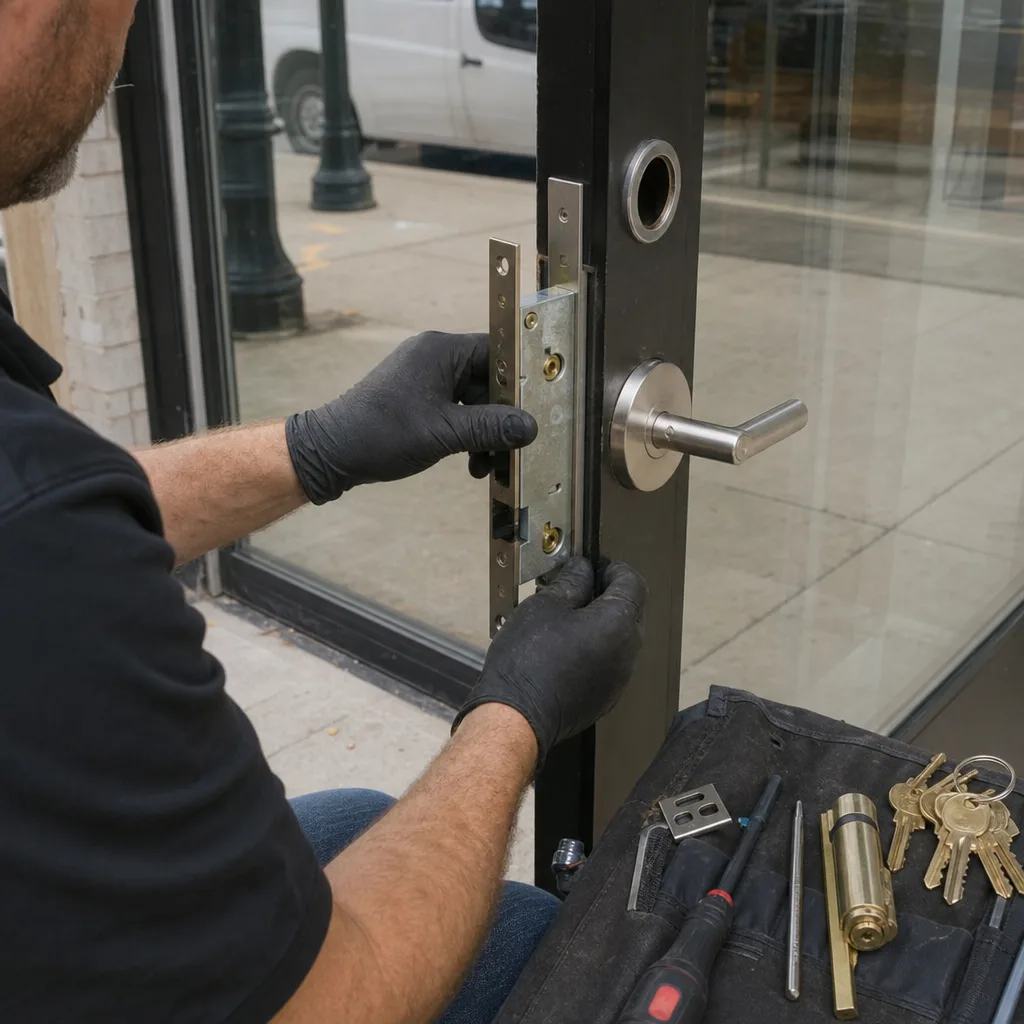
Illinois Fire Prevention Code (adopted from NFPA 101) mandates that exit devices, commonly called panic hardware, function with a single motion and release the latch without key operation from the interior. Chicago Fire Department inspectors enforce this during annual inspections of commercial occupancies, and the penalty for noncompliance is not a warning. It’s a correction order with a 30-day compliance window, followed by fines and potential occupancy restriction.
The specific failure modes we see in Chicago:
- Dogging mechanism failure: The hex-key or cylinder dogging that holds the push bar retracted fails to release, meaning the latch never projects. The door appears secure but offers no latching. CFD inspectors test this by attempting to pull the door open from the exterior.
- Rim device vertical rod misalignment: Thermal expansion in steel doors causes the top or bottom rod to drift out of strike alignment. The device pushes, the latch doesn’t engage, or engages incompletely. In a fire, this is a life safety failure.
- Exit alarm integration fault: Many Chicago commercial properties install delayed egress or alarmed exit devices. If the alarm fails to sound or the delay exceeds 15 seconds, the device is noncompliant.
The Chicago Fire Department publishes no public list of inspection dates. Inspections are unannounced. The only protection is proactive maintenance: test every exit device monthly for full latch projection, test dogging release, and verify alarm function if equipped. Document the test with date, technician name, and result. This documentation is your evidence of due diligence if an inspector finds a fault.
Replacement intervals for exit devices in Chicago: 10-15 years for Grade 1 rim devices in climate-controlled interiors, 7-10 years for devices on exterior doors subject to freeze-thaw. Brands like Von Duprin 99 Series and Sargent 8800 Series are the standard we install. We quote these in writing before any work begins, per Haven Standard Clause 1.
Freeze-Thaw Damage: What Fails First and When to Inspect
Chicago averages 22 freeze-thaw cycles per winter, and each cycle moves a steel door frame approximately 1/16 inch relative to its strike. Over a season, that movement compounds into latch misalignment, closer fluid leakage, and threshold plate separation from the substrate. The failure follows a mechanical sequence, and the component to inspect first each November is the door closer.
Here’s the sequence:
- Door closer arm or pivot cracks: The closer body contains hydraulic fluid that thickens in cold. The arm transmits force to a frozen or sluggish piston, and the resulting stress fracture appears at the arm-to-spindle junction. Inspect for oil seepage at the closer body and play in the arm connection. A leaking closer will fail completely within 30 days of first seepage.
- Latch-strike misalignment: Frame movement shifts the strike plate. The latch begins to scrape, then fails to engage. Check for metal dust or scoring on the strike face. If you see bright metal where the finish has worn through, alignment correction is needed.
- Threshold plate lift: The aluminum threshold expands and contracts at a different rate than the concrete or steel substrate. Sealant fails, water enters, freeze-thaw pops the threshold. This creates a trip hazard and allows water under the door, accelerating frame corrosion.
- Weatherstripping compression set: After two Chicago winters, standard pile weatherstripping loses resiliency. Light visible around the door perimeter indicates air infiltration, which carries moisture to the lock mechanism.
Our November inspection protocol, developed across 60,000+ lock and door hardware installations since 2002, prioritizes the closer. A failed closer causes the door to slam, which accelerates hinge wear, which increases frame stress, which finishes the lockset. Fix the closer first.
In neighborhoods like Bronzeville and Bridgeport, where many commercial buildings date to the 1920s-1950s, frame settlement adds a chronic misalignment factor. We measure door-to-frame clearances at three points (top, middle, bottom) and record the variance. Anything over 1/8 inch indicates the need for hinge adjustment or strike relocation before winter.
Master Key System Audits and Rekeying Schedules
A master key system allows one key to operate multiple locks while subordinate keys operate subsets. In Chicago commercial properties, these systems are common in multi-tenant buildings, office suites with shared conference rooms, and properties with separate owner, manager, and maintenance access levels. The security of the system depends on two factors: the bitting security of the keyway (how many possible combinations exist) and the documented control of key copies.
Most Chicago businesses we audit have no key control log. Keys were issued to employees, contractors, or previous tenants, and there’s no record of how many copies exist or who holds them. This is a security gap that rekeying alone doesn’t fix.
The audit protocol:
- Annual key inventory: Physically count every issued key against the log. Missing keys trigger a rekey of the affected cylinder.
- Bitting analysis: For systems using standard keyways (Kwikset, Schlage C-keyway), the number of possible combinations is low enough that a determined attacker with a set of blanks can progress the system. High-security cylinders like Mul-T-Lock or Abloy use patented keyways that cannot be duplicated without authorization and resist picking and bumping by standard tools.
- Rekeying schedule tied to turnover: We recommend rekeying at every employee departure with key access, every contractor change (cleaning, security, IT), and every tenant turnover in multi-tenant properties. The cost of rekeying a standard cylinder in Chicago runs $25-$45, quoted in writing before we start. The cost of an undetected unauthorized key is a break-in, an insurance dispute, or a lease violation.
For properties with complex master key systems, we provide a written scope before any rekeying work, identifying which cylinders change, which remain constant, and how the new bitting integrates with the existing hierarchy. This prevents the common error of rekeying a cylinder and accidentally voiding the master key’s access to it.
Our access control systems in Chicago can replace or supplement master key systems for properties with high turnover or audit requirements. The hardware records every entry with timestamp and credential ID, and the audit trail satisfies most insurer documentation requirements.
How to Log Inspections for Landlord and Insurer Documentation
After a break-in, a fire inspection failure, or a liability claim, the first document requested is the maintenance record. Chicago commercial tenants who cannot produce one face lease termination, coverage denial, or contributory negligence findings. A proper log transforms your maintenance program from an expense into a legal defense.
The log should contain:
- Date and time of inspection
- Name and affiliation of inspector (employee, property manager, or external technician)
- Hardware location and description (e.g., “Front entrance, Sargent 10-Line cylindrical lockset, installed 2019”)
- Condition observed (specific, not generic: “Latch retracts smoothly, no play in spindle, keyway shows minor wear, no corrosion”)
- Action taken or recommended (“No action,” “Schedule closer replacement Q2,” “Rekey due to key unaccounted”)
- Photo record
At Novak Lock & Security Chicago, every visit includes a documented photo record left with the customer at job completion. This is standard, not an upgrade. The photos show hardware condition before and after any work, and they are dated and referenced to the written invoice. For our commercial maintenance contract clients, we compile these into an annual summary report suitable for landlord submission or insurance renewal.
The Haven Standard requires this documentation on every visit, across all ten Haven brands. Clause 4 specifically: “A record of condition, action, and result accompanies every invoice.” If your current locksmith doesn’t provide this, you’re carrying an undocumented risk.
The Monthly, Quarterly, and Annual Checklist

This is the operational core. Assign responsibility, set calendar reminders, and execute.
Monthly (15 minutes per door)
- Visually inspect exit devices for physical damage, missing fasteners, or alarm indicator faults
- Cycle each lockset: key insertion, turn, latch retraction, door operation, latch engagement
- Check door closer for oil leakage at body and arm connection
- Verify door latches fully without push or pull assistance
- Inspect weatherstripping for gaps, tears, or compression set
Quarterly (30 minutes per door)
- Remove lockset escutcheon and inspect cylinder for corrosion, loose mounting screws, or keyway deformation
- Test master key and all subordinate keys for smooth operation
- Check strike plate fasteners; tighten or replace if loose
- Test exit device dogging and release; verify full latch projection
- Inspect threshold plate adhesion and sealant condition
- Update key control log for any copies issued or returned
Annual (professional service recommended)
- Full hardware grade assessment: identify any Grade 2 or 3 hardware in commercial use
- Master key system bitting analysis and security assessment
- Door alignment measurement at three points; correction if variance exceeds 1/8 inch
- Fire code compliance verification for all exit devices
- Replacement scheduling for hardware approaching rated cycle limit
- Documentation compilation: annual summary report with photo record
In our experience across Chicago commercial properties, the annual professional audit catches 40% more issues than even diligent in-house quarterly inspections. The difference is tooling: we measure latch engagement depth with a caliper, test closer closing speed with a stopwatch, and verify cylinder pick resistance with professional tools. These measurements reveal degradation before it becomes failure.
What Professional Maintenance Costs in Chicago
We quote every job in writing before we start. Haven Standard Clause 1: the price on the phone is the price on the invoice. Here are the ranges we see in the Chicago market for commercial locksmith maintenance:
| Service | Typical Range | Notes |
|---|---|---|
| Annual maintenance audit (per door) | $45-$85 | Includes inspection, documentation, photo record; volume discounts for 10+ doors |
| Cylindrical lockset rekey | $25-$45 per cylinder | Quoted per cylinder; master key systems may require additional pinning |
| Grade 1 cylindrical lockset replacement | $280-$450 installed | Includes Sargent, Schlage, or equivalent; high-security cylinders like Mul-T-Lock add $150-$300 |
| Door closer replacement | $220-$380 installed | Standard duty; heavy-duty or concealed closer higher |
| Exit device inspection and adjustment | $95-$165 | Per device; includes latch alignment, dogging test, alarm verification |
| Exit device replacement (Grade 1 rim) | $650-$1,100 installed | Von Duprin or Sargent; includes fitting and strike adjustment |
| Master key system rekey (complex hierarchy) | $45-$95 per cylinder | Depends on levels of keying and bitting complexity |
There is no call-out surcharge added on arrival. The price we quote includes travel, labor, and materials. If we discover additional needs during the audit, we stop, explain, and quote the addition before proceeding. The technician is contractually prohibited from changing the price at the door. This rule has been in place since 2002.
We also offer a Free Second Opinion on Any Written Estimate. Bring us a competitor’s quote and we will review it at no charge. We’ve found that 30% of competitor quotes in the Chicago market omit necessary hardware or specify Grade 2 devices where Grade 1 is code-required.
Common Mistakes to Avoid
- Using residential-grade hardware in commercial applications. Grade 3 locksets fail within months on a commercial door, and their presence can void insurance coverage after a break-in. We’ve found Grade 3 hardware in Chicago restaurant alley doors, installed by handymen who didn’t know the difference.
- Ignoring the closer until it leaks on the floor. A leaking closer has already damaged itself and is stressing the entire door system. The $280 closer replacement becomes a $700 door and frame repair.
- Rekeying without updating the key control log. The new keys are secure only if you know how many exist and who holds them. A rekey with no log update is security theater.
- Assuming CFD will announce inspections. They don’t. The only protection is continuous compliance, documented.
- Letting a tenant or employee “fix” the lock with WD-40. This attracts dust, gums the mechanism, and voids most manufacturer warranties. Proper lubricant for lock cylinders is graphite or a PTFE-based product specified for the application.
- Failing to inspect after any door or frame repair. New paint, new threshold, or hinge replacement changes alignment. Always re-verify latch engagement and closer operation after any door system work.
- Buying hardware online without verifying Chicago code compliance. That exit device from a discount supplier may lack the UL label or the Chicago Fire Department acceptance certificate required for installation.
When to Call a Professional
Call a professional when any of the following occurs: a key that previously operated smoothly now requires jiggling or force; a door closer shows oil leakage; an exit device fails to latch consistently; you’ve had a break-in or discovered a missing key; you’re approaching a lease renewal or insurance renewal and need documentation; or you’ve received a correction order from Chicago Fire Department. These are not maintenance items. They are active failures or compliance exposures.
We also recommend professional involvement for any hardware replacement on fire-rated doors. The label on the door frame specifies the hardware that maintains the rating. Installing non-listed hardware voids the fire rating and exposes the property owner to liability.
Novak Lock & Security Chicago offers free estimates for commercial maintenance programs. We serve properties in the Loop, River North, West Loop, Lincoln Park, Lakeview, and throughout the metro area. Call (331) 202-1318 to schedule an audit or request a written scope for your property.
Frequently Asked Questions
Annual professional maintenance audits typically run $45-$85 per door, with rekeying at $25-$45 per cylinder and Grade 1 lockset replacement at $280-$450 installed. We quote every job in writing before we start, and the technician cannot change the price at the door. Call (331) 202-1318 for an exact quote for your property.
Yes. Haven Standard Clause 1 states that the price quoted by our dispatcher is the price on the invoice, with no exceptions. The technician is contractually prohibited from adding charges on arrival. If we discover additional needs during the visit, we stop and quote them separately before proceeding.
Our calls are answered by a live person, 24/7, with no voicemail queue. Emergency response times vary by location and traffic conditions, but we prioritize commercial lockouts and dispatch immediately. For maintenance scheduling, we typically book within 48 hours. Call (331) 202-1318 for current availability.
Every technician is background-checked and uniformed, and every visit includes a documented photo record left with you at completion. We are factory-authorized for premium brands including Mul-T-Lock, Abloy, and Baldwin, and all work is backed by our 365-Day Done Right Promise. We’ve installed or serviced 60,000+ locks, keys, and systems since 2002.
You receive a correction order with a 30-day compliance window. If the device is nonfunctional, the building may be restricted from occupancy until repaired. Proactive monthly testing and documented annual professional inspection are your only protection. We provide inspection documentation suitable for CFD submission.
For any employee with key access to sensitive areas, yes. The cost of rekeying a cylinder in Chicago is $25-$45. The cost of an undetected unauthorized key is unpredictable. We recommend a written rekeying policy tied to your HR offboarding checklist, with a key return confirmation signed by the departing employee.
Monthly visual and operational checks can be performed by any competent employee with a checklist. Annual professional audits are where we find the issues that untrained inspection misses: subtle latch misalignment, closer speed drift, cylinder wear patterns, and code compliance gaps. The combination of in-house monthly and professional annual is the most cost-effective program we’ve seen.
The Bottom Line
Commercial door hardware in Chicago fails on a schedule you can predict and prevent. The freeze-thaw cycle, traffic volume, and fire-code compliance requirements create specific inspection intervals: monthly for operational function, quarterly for mechanical condition, annually for professional assessment and documentation. Properties that follow this protocol avoid the emergency calls, inspection penalties, and security gaps that reactive maintenance invites. The cost of prevention is modest and fixed. The cost of failure is variable and often severe. Start with the November closer inspection, maintain the key control log, and build the documentation habit that protects your lease, your coverage, and your operation. For more guides & resources, visit our blog.
Written by Daniel Novak, Owner at Novak Lock & Security Chicago, serving Chicago since 2002.